Environmental Pressure
Extreme heat, alkaline dust, intermittent water, violent weather, and rapid habitat disappearance favored organisms able to survive unstable physical conditions.
Salmo spectralis deserti — provisional classification
A semi-visible migratory fish of uncertain biological status and undeniable cultural significance.
The Desert Ghost Salmon appears to inhabit the unstable threshold between ecology, memory, rumor, ritual, collective attention, and whatever exactly has been happening in the Black Rock Desert for the last forty years.
The Bureau currently lists the species as Unconfirmed / Endangered / Spiritually Relevant. Its biological existence remains unresolved. Its cultural, emotional, and administrative existence is increasingly difficult to dispute.
Premature disbelief is not recommended. It has been associated with weak migration signals, reduced visibility, and preventable losses of wonder.
The Bureau does not believe the species originated locally through conventional freshwater evolution.
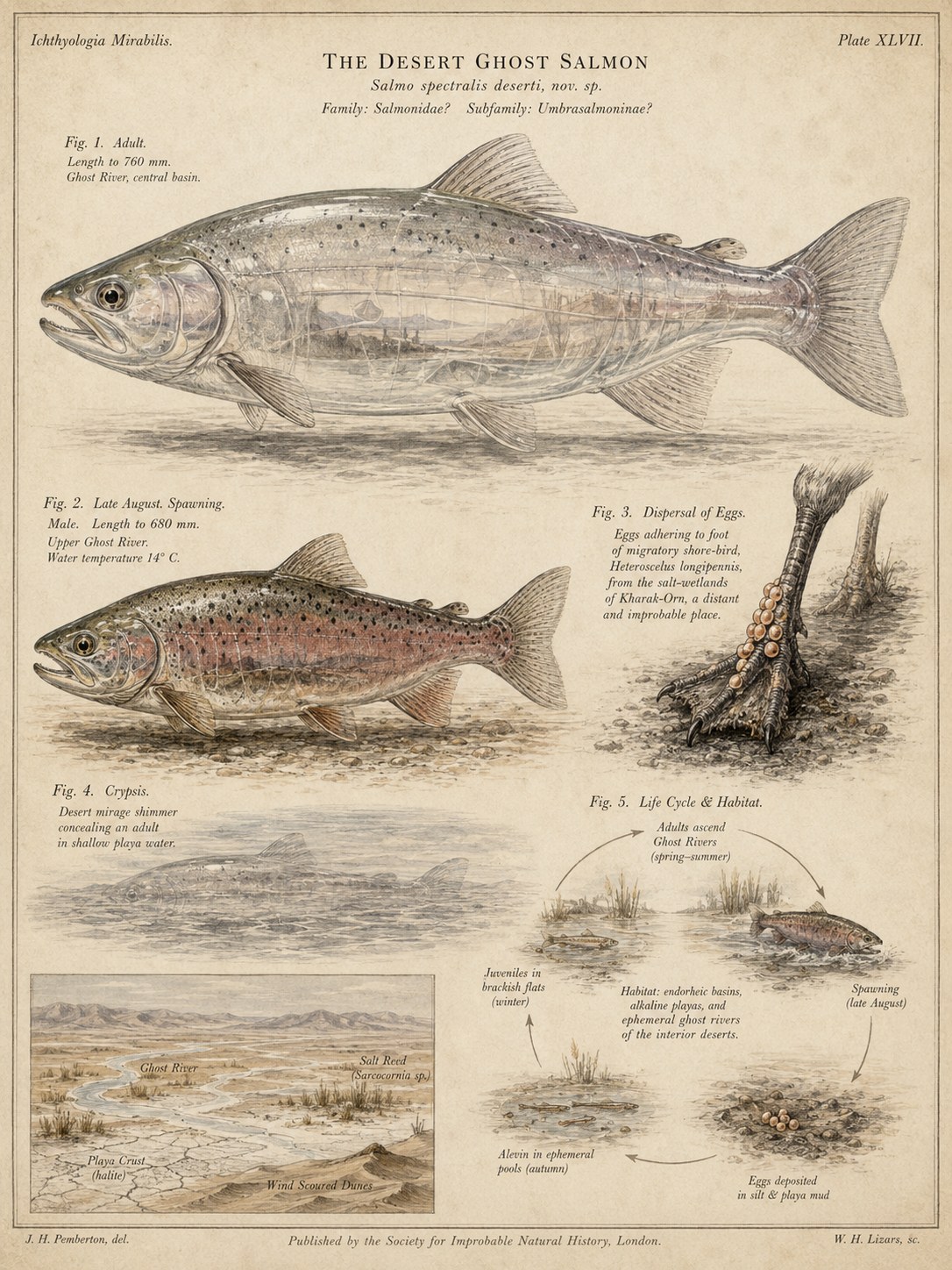
The leading hypothesis proposes that viable eggs were carried into the basin on the muddy feet of migratory birds. The source population may have occupied a distant saline wetland, a forgotten estuary, a vanished inland sea, or another improbable place no longer represented on current maps.
Eggs deposited in a temporary desert wetland would normally have had little chance of survival. What followed, however, was not a normal environment.
For roughly forty years, a temporary city has repeatedly appeared inside the suspected range of the species. Each cycle has introduced extraordinary concentrations of dust, weather, fire, music, impossible architecture, exhaustion, grief, intimacy, laughter, tears, joy, ritual, rumor, and collective invention.
Extreme heat, alkaline dust, intermittent water, violent weather, and rapid habitat disappearance favored organisms able to survive unstable physical conditions.
Recurring waves of emotional experience may have exerted a second form of pressure: adaptation to grief, euphoria, wonder, intimacy, and collective attention.
Individuals most capable of surviving as stories, rumors, symbols, and memories persisted after conventional habitat vanished.
The resulting species may now exist simultaneously as fish, witness, image, rumor, emotional event, and administrative problem.
“The Desert Ghost Salmon may be the first documented fish species shaped as much by attention as by habitat, and as much by ecology as by forty years of collective human mythmaking in the Black Rock Desert.”— Black Rock Desert Salmon Bureau
The landscape may remain partly visible through the body. Witnesses have reported mountain lines, city lights, dust storms, and unrelated memories appearing within the fish.
The species merges with heat shimmer, salt glare, reflection, and shallow water. Direct observation is often less reliable than peripheral vision.
Visibility increases when stories are repeated with conviction, illustrated carefully, and supported by convincing government-style documentation.
The species appears to use public attention as an ecological resource. It becomes more stable when noticed, searched for, protected, and expected.
Spawning occurs in late August of each year.
Adults are believed to ascend ephemeral ghost channels and deposit eggs in wet silt, saline mud, shallow protected basins, and emotionally charged microhabitats near structures convincingly resembling bridges.
The overlap between spawning season and the annual appearance of a temporary city within the species’ range remains officially classified as a coincidence. The Bureau no longer considers this coincidence reassuring.
Dispersed by water, mud, wind, bird feet, and insufficiently verified explanations.
Occupy briny pools, wet playa margins, seasonal channels, and overlooked pockets of reality.
Travel through underground, ephemeral, or narrative waterways during spring and summer.
Return in late August when moonlight, calm weather, strong stories, and bridge access permit.
The species prefers liminal zones that cannot be assigned confidently to either water or land, fact or rumor, camp or open playa.
No direct feeding event has been documented. Stomach-content analysis remains unavailable for reasons including the absence of a stomach and the absence of a specimen.
The Bureau strongly discourages throwing completed explanations into the suspected river.
The most obvious threat. Total water absence does not always stop migration, but makes it considerably harder to document.
Long-term exposure may reduce narrative density and damage the conditions required for collective observation.
Without continuing interest, the species may retreat into less accessible layers of myth.
Too much rational certainty can damage spectral integrity and eliminate necessary ambiguity.
Reducing a complex ecological and cultural system to a single meme is considered a form of habitat degradation.
Insufficient crossing infrastructure may interrupt migration and reduce the administrative credibility of the river.
The first credible advisory regarding the ghost river was provided by a rare trout informally identified as Mike.
Mike submitted no written statement. She maintained sustained eye contact and, according to Bureau interpretation, communicated enough detail to authorize an immediate field expedition.
Status: associated species / confidential trout source / possible regional informant.
Read Field Report 001Repeat the story accurately enough to strengthen migration, but inaccurately enough to allow the species to continue evolving.
The species may remain biologically unconfirmed while already possessing a stable habitat in stories, expectation, collective memory, and the physical infrastructure now being created for its protection.
The Bureau considers further investigation justified.